Angraecums

Angraecums
Angraecum leonis

Monday, February 25, 2013

Angraecum leonis (Size Identifies)

     In August of 2012, the initial post regarding Angraecum leonis was published in the blog.  Since then, I have received numerous emails and questions dealing with the two varieties of Angcm. leonis.  The questions center around the distinctive differences between Angcm. leonis from Madagascar and Angcm. leonis from the Comoro Islands.  This post will give a visual description of the two varieties along with a review of the culture that I use to grow these phenomenal plants.
     As stated in the original post, the Angcm. leonis from Madagascar is the smaller of the two varieties.  It grows at the very northern tip of Madagascar at about sea level where the annual rainfall is nothing compared to the amount of rain that the variety from the Comoro Islands receives.  The amount of rainfall has a big play into the size of the two varieties. 
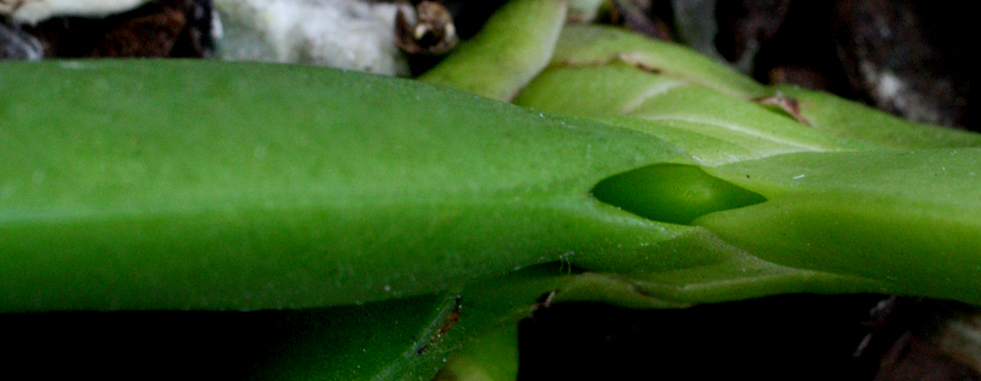
     With less rainfall, the Madagascar version is usually half the size.  The leaves are shorter but are very fleshy.  The thickness of each leave can be 2 - 2 1/2 times as thick.  The leaves hold moisture due to the fact they receive less rain.  As I have shown with other Angraecums, when the plants are exposed to more moisture, they have a tendency to become larger plants.  When they are not, they adapt to survive.

Angcm. leonis (Madagascar version) the thick fleshy leave
                                      retains what moisture it can get due to the dry climate.
 
     The leaves of the Madagascar version are about half the size on a mature plant compared to the version from the Comoro Islands.
 
Angcm. leonis (Madagascar version) the longest leaf on this
                                      mature plant is less than half the size of a leaf from the
                                                               Comoro Islands version.
 
Angcm. leonis (Comoro Islands version) the leaves on each
side of the plant are just about the same length.  Can reach
an overall combined width of 14 plus inches (35 cm) on a
well established mature specimen.
 
     Both versions of Angraecum leonis will do well mounted to a cork or a tree fern slab.  During the warmest part of the growing season, the plants must be watered daily with an additional misting later in the afternoon.  If you see that there are wrinkles forming in the leaves, hydrate the plant several times a day until the wrinkles start to disappear.  If the plants have been mounted with any moss around their base, be sure to thoroughly soak the material (it will dry out quickly during the summer heat and with any breeze blowing).
     Either version can be potted or placed in baskets with a fast drain medium.  The roots of plants that have been placed in pots can develop root rot if not allowed to partially dry.  Very often when the leaves start to show wrinkles, it can also spell out the fact that the roots have rotted and the plant is not getting sufficient moisture even if you're watering on a regular basis. 
     Keep an eye on potted plants!  In sub-tropical and tropical climates, it is best to use a non-organic material when potting or placing plants in baskets.  This very warm and humid climate will brake down the organic mediums very quickly forcing you to change the medium more frequently.  This does not bode well for the root systems.
     Flowers of the two versions of Angraecum leonis is also another tell tale sign as to the identity of the plant.  The Madagascar version of Angcm. leonis is only about 1 - 1 1/2 inches (3-4cm) wide and about 1 1/2 - 2 inches (4-5cm) high with a nectary/spur about 2 3/4 - 4 inches (7-10cm) long.  The Comoro Islands version is about 2 1/4 - 3 inches (6-9cm) wide and about 3 inches (8cm) high with a nectary/spur of about 3 1/2 inches (9cm) long.  Both versions are scented and can last up to four weeks if the plants are not exposed to harsh weather while in bloom.
     One last visual point of difference between the two Angcm. leonis versions is the shape or the bends of the nectary/spur.  The nectary of the Comoro Islands version goes back behind the flower draws down and then comes forward underneath the flower.  The Madagascar version will go behind the flower, draw down and as it comes forward reverse again to form the letter 'S'.  These are common traits but keep a mental note that not everything is written in stone.
 
The Comoro version on the left while the Madagascar version
is on the right showing the letter 'S' in a developing bud of
Angraecum leonis.
 
     No matter what version you are growing, you will be very pleased once the plant starts producing flowers on a yearly basis. 

Wednesday, February 6, 2013

Oeoniella polystachys

     Oeoniella polystachys is one of the few Angraecoids that inhabit all three island chains that surround Madagascar; the Comoro Islands west of the northern tip of Madagascar, the Mascarene Islands to the east of Madagascar and the Seychelle Islands to the north and northeast of Madagascar as well as inhabiting the lowlands of eastern Madagascar itself.  An epiphyte that grows primarily on trees not much higher than sea level.

Oeoniella polystachys
 
     The main reason I started growing Oenla. polystachys is because of the sub-tropical growing conditions here in South Florida.  It thrives on large amounts of moisture and has a very short rest period.  I started with plants in pots and mounted to tree-fern totems.  In just a few short months, I eventually mounted all of the plants due to the aerial roots coming from the plant as it grows.  It is almost always in a growing phase, no matter the time of year.  As you can see in the image below; it was potted as a seedling and already in bloom for the first time.  After learning more of the plants characteristics and realizing that it climbs somewhat, I thought it best to mount.
 
Oenla. polystachys first time blooming
 
     Mounted to a tree-fern totem, Oeoniella polystachys will eventually start attaching itself to the totem.  Aerial roots will form up the length of the plant usually to within 4 inches (10cm) from the top.  It is best to have a bed of moss at the base to help hold moisture until the aerial roots have taken hold.  The roots form just above the old inflorescence or opposite the leaf axils.  Most of those roots will find the totem material and grab hold.  Although I eventually mounted the plants that I had put in pots, doesn't mean you shouldn't grow them that way.  My suggestion is that the pots be at least 5 - 6 inches (13-15cm) wide and a medium that would allow fast drainage and giving the roots the air that they need.  The stems of the plants have the capability to grow to 24 inches (60cm) tall but are very seldom seen that high.  To keep the plant from dropping over or becoming pendant, they should be staked or supported in a manner to keep them erect.  Oenla. polystachys can start to branch heavily and keeping it erect will give the added support necessary.
     Plants that are mounted should be watered daily and when temps reach above the mid 80s F, they should be watered or misted a second time about two - three hours prior to sunset.  Allowing the plant ample time to dry before dark.  Plants that are potted should be watered every 2 - 3 days and when warmer temperatures arrive, mist the plant mid to late afternoon.  As stated earlier, Oenla. polystachys  has a very short rest period.  Watering should not be backed off unless temperatures drop below 70 degrees F.
     Oeoniella polystachys will do very well in a warm greenhouse in the cooler/colder parts of the northern hemisphere while mounted or potted.  If the plants are kept indoors such as a home, they should not be exposed to temperatures below 70 degrees F for any great length of time.  As long as warm temperatures are maintained, watering habits should not change.  Please note; if temperatures do lower, watering can be cut back to every other day when mounted and every 4 days while in a pot.
 
Oeoniella polystachys mounted to a tree fern totem
 
     Oenla. polystachys is capable of taking very bright light as long as it is diffused or spackled the entire day.  Most of my plants receive a fare amount of direct sunlight until about noon or mid-day.  During the hotter part of the day, mid-after to late afternoon, the light is toned down.  A bright shade or 25 percent spackled light works well.  It is imperative that a good air movement be available; if it is not, do not expose the plant to any direct sunlight, keep it in a bright shade or a spackled light.
     A mature, well nurtured plant should bloom or be in bloom twice a year; with a 2 - 4 month break in between.  The inflorescence develop at the opposite side of the leaf axils and are about 6 - 10 inches (15-25cm) long.  Each inflorescence carrying 10 - 15 flowers.  Mature plants can produce 5 - 7 spikes at one time.  The flowers range in width, 3/4 - 1.5 inches (2-4cm) across.  The spur/nectary is about 1/4 inch (.6cm) long forming at the base of the lip and tapers at the tip.  Flowers can last 3 - 4 weeks and longer if the plant is protected from harsh weather conditions and are fragrant in the early part of the evening.
 
Oeoniella polystachys
 
     My plants are fertilized every 7 days with a well rounded and balanced fertilizer year round.  They are treated every 30 days with a systemic fungicide that I switch every three months.  I am always on the lookout for signs of fungus on the bottom side of the leaves.  A wet climate for too long of a period or cooler weather can bring about fungus issues.  Keeping a quart spray bottle of a topical fungicide is a great idea.
     Oeoniella polystachys is a phenomenal plant for those that keep warm conditions year round. Like any other Angraecoid, give it what it requires and then be prepared for outstanding flowers.     

Sunday, January 27, 2013

Aerangis citrata

     Aerangis citrata, the Latin interpretation means "lemon-colored", referring to the two small bead shaped tops of the anther cap.  When first opened, the lemon color is very pronounced.

Aerangis citrata
 
     Formerly known in some circles as Angraecum citratum, Aerangis citrata is found throughout Madagascar.  From the southeast coast through the central part of the country into the northwest section.  It is an epiphyte growing on lower branches that can be found at sea level to about 4,900 feet (1,500m).  It is almost always found near water of some sort and is highly adaptable in several types of climate as long as the moisture is available.
     Aerangis citrata is a very easy plant to grow.  It is often sought after by collectors that prefer mini or small species because it will grow and thrive under lights.  A decent specimen plant will bloom 2 - 3 times during the year and will produce numerous inflorescence with as many as 15 - 20 flowers.
 
Aerangis citrata
 
     As with all of my Aerangis that I grow, Aergs. citrata is grown mounted to cork slabs.  I prefer the plants to be slightly pendant so that any excess water does not sit in the leaves against the stem.  The water runs off of the plants easily.  This also allows the inflorescence to freely become pendant and the flowers can be seen at just about any angle. 
     During the warm late spring, the hot summer and into early fall, the mounted Aerangis' are watered every day.  When temperatures reach the mid eighties and into the nineties, the plants are also misted heavily in the afternoon hours.  Giving them enough time to dry off prior to night fall.
When temperatures do cool down into the low seventies and lower; the watering frequency is cut back to just misting in the morning and regular watering every three days.  It is important to mist the mounted plants throughout the warmer days because the plant can dehydrate without enough moisture.
     As stated earlier, the plants are highly adaptable and can handle the warm summer days and cooler temps of fall and winter.  For plants that are grown in the hobbyists' home in colder regions; be sure to keep them away from direct contact of windows where temperatures can be 10 - 15 degrees F (6-9C) cooler than a spot on a table just a few feet away.
     The amount of light that my plants receive is no brighter than bright shade and have been placed in areas for short periods of time that is less than average Phal light.  Aerangis citrata should not get any direct sun light.  The leaves are broad and thin enough that they will burn easily and dehydrate the plant itself.  It will do well in average Phal light.
     For those of you that are growing Aerangis citrata in small pots; be sure that the mix you're using drains and no excess water sits in the pot.  Although the plant requires and thrives on that moisture, you do not want the roots to rot.  The stem's average height is about 2.4 inches (6cm) and will hold 6 - 8 leaves that are 3 - 4.7 inches (8-12cm) long by 1 - 1.5 inches (2.5-4cm) wide.  It will do very well in a 3 - 4 inch (8-10cm) pot and should not out grow it.  If the medium that you are using does start to break down, re-pot the plant at the beginning of the growing season (early spring) so that the plant does re-establish itself quickly.
     I use a standard fertilizer once a week throughout the entire spring, summer and early fall.  Once the watering is backed off, I eliminate the fertilizer until spring or when the new growth begins.  A systemic fungicide is applied every three to four weeks and I keep a watch for small issues due to the amount of water given to the plants.  Insecticides and mite-icides are applied every 6 - 8 weeks and a small amount is kept on hand in case there are any problems.  Here in South Florida, spider mites can creep up suddenly as well as white fly problems (which have become a big nuisance in the last year or so).  Watch for scale on the inflorescence as they develop.
     During the blooming periods, inflorescence will grow from the leaf axils.  Each can be up to 10 inches (25cm) long and carry up to 18 flowers.  Buds will form along the entire length of the flower spike about .4 inches (1-1.3cm) apart and will always face in one direction.  Flowers are .6 - .7 inches (1.5-1.7cm) wide by .7 - .8 inches (1.7-2.0cm) high.  Each flower has a club shaped nectary or spur that is about 1.2 inches (3cm) long.  It is usually green from the throat of the flower turning a pristine white at the last quarter length of the tip.
 
Developing buds & flowers of Aerangis citrata
 
     Once the inflorescence has grown and the buds begin to develop, they all develop upright.  The short nectary will already be in position and that is facing down or dropping down.  The flowers will open successively.  Those being closest to the plant opening first and then towards the tip.  It is said that the flowers have a faint citrus fragrance, although I have never picked up on that.
     Aerangis citrata will become a beautiful specimen plant in 3 - 5 years after it's first blooms appear.  Be sure to give it the proper care and meet its requirements and the plant will bless you with numerous flowers a few times a year.  


Monday, January 21, 2013

Angraecums in Fort Lauderdale

     The Fort Lauderdale Orchid Society held their 53rd Annual Orchid Show this past weekend.  They held a Preview Party on Thursday evening kicking off the show which was attended by several hundred guests.  The show officially opened Friday morning and ended the day with a record number of patrons attending.  Saturday and Sunday were just as busy and vendors that lived close enough were scrambling back to their green houses for more product.  All in all it has been declared an unofficial huge success.  That brings me to the real reason for this post.  Angraecums at the Ft. Lauderdale Show; not for sale, but plants that were used in the vendors displays.  T-h-r-e-e !
     I think its sad that the twenty-two orchid vendors that are required to set up displays; only three used an Angraecum.  I realize that the displays showcase the plants that each vendor may be known for or plants that they have specialized in hybridizing.  Yet each grower still uses plants that they sell to fill in spots or fill a design plan.  This time of year, their are several very large and showy Angraecums available in bud and in bloom.  Yet very few of the growers use the Alliance for display let alone attempt to sell.
     Setting aside the displays for a moment, I will say that there were several vendors with a slight selection of Angraecums.  One vendor from California, Cal Orchids had a decent selection of miniature and compact Angraecoids.  Of which I obtained numerous plants.  The point that I'm getting to is this; the Angraecum Alliance is not a popular group of plants.  There are over 600 species of Angraecoids with a large volume of hybrids now available.  The big showy plants such as Angcm. sesquipedale, Angcm. eburneum, not to mention some of the hybrids, Angcm. Veitchii, Angcm. Crestwood and Angcm. Lemforde White Beauty have gained some popularity.  When you see mature plants at the orchid shows, you see some heavy duty prices.  Many people don't want to bother with a seedling because of the amount of time it will take to grow into a prize winning specimen.  I can't forget to mention that some growers and hobbyists are afraid to grow them thinking that the plants are too demanding.  That their requirements are to stringent.  I will admit that some of the Angraecoids are a bit finicky; but think of this, give the plant what it needs and you'll be rewarded with the most beautiful flowers you can imagine.  Most are fragrant at night and will last several weeks or more.

Angraecum Veitchii
 
     The plant in the image above is an Angcm. Veitchii.  It was the first Angcraecum hybrid between Angcm. eburneum crossed with an Angcm. sesquipedale.  Many people are not aware of the fact that the hybrid suffers from "Twisty Flower"; and it has suffered from this affliction from day one (1899).  The seed parent, Angcm. eburneum has a superior lip.  It has turned up an erect, like a hood.  The pollen parent, Angcm. sesquipedale, has an inferior lip, it is down and points out.  The terms superior and inferior have nothing to do with quality; it is just the terminology used for the type of lip the flower has.
     Angcm. Veirchii is the offspring and its flowers can't seem to make up their mind as to how the lip should position itself.  Therefore, each flower opens facing the ground or being parallel to it.  You never seem to see the face of the flower.  The trick here is to wait for the first flower at the tip of the spike to start to open.  As soon as you see the sepals of the bud starting to split, stake the spike upright.  The flower will open facing out as will each flower after that.  Stake the spikes to soon and the flowers will still open facing down.  Once you've staked the spikes properly, you can now enjoy your hard work and enjoy the large showy blooms.
 
Angraecum Crestwood
 
     The image above shows an Angcm. Crestwood.  It is the offspring of a cross between Angcm. Veitchii and Angcm. sesquipedale.  By introducing Angcm. sesquipedale into its own offspring, the flowers have become larger, a more pristine white and they no longer suffer from "Twisty Flower".  Each flower opens facing out, however the nectary or spurs have a tendency to stick out and away from the bloom rather than hang down.  This individual plant was very well grown and cared for.  The leaves were spotless and the height of the plant was just over 18 inches (45cm) tall.
 
Angraecum eburneum
 
     The last Angraecum to make an appearance at the Ft. Lauderdale Orchid Society's show is Angcm. eburneum.  The plant is a species and is the seed parent of Angcm Veitchii.  Its flowers are tightly grouped on staked spikes; in the wild the inflorescence is usually some what pendant like.  The plant can reach close to 5 1/2 - 6 feet (1.8m) in the wild.  Both of these plants were close to 3 feet (1m) high.
     All of these Angraecums are fragrant at night and do well in a coarse medium; allowing the root system quick drainage and the chance to breath.  They really don't have a rest period during the winter months like some of the small Angraecoids do.  With the proper care they can outlive their owners.


Thursday, January 10, 2013

Angcm. magdalenae & Her Hybrids

     With some reluctance, I've decided to publish this post in its unfinished state.  The main reason is the lack of information I've been able to gather or should I say NOT gather.  It has been a very slow process and I know that their are numerous readers that have been waiting for this post.  I will continue to add to it over the next several weeks or months for that matter as I gather more information.  I am sorry to say that its beginning is rather bleak.
     As I had stated in a post made on the tkangraecums page in facebook; one of the first readers of the blog asked a very simple question.  They knew of two hybrids (Angcm. Lemforde White Beauty and Angranthes Grandalena) created from Angcm. magdalenae but wanted to know if there were any others available.  Before I answer that question, let me say that the reader is very passionate about the species Angcm. magdalenae; as well she should be.  She presently has three Angcm. magdalenae and two Angraecum Lemforde White Beauties.  Many botanists consider the species near extinct while a few do use the word extinction.  It is hobbyists like this reader and myself and so many others; along with some growers that are trying to keep the species alive by growing them in their private collections.  It would be a shame to sit back and watch as one of the most beautiful Angraecums disappears into oblivion.

Angraecum Lemforde White Beauty
(Angcm. magdalenae x Angcm. sesquipedale)
(Lemforder Orchids - Originator, Registered 1984)

     Now, the answer to that question is that there are twenty registered hybrids.  I am not using the word available.  The first registered hybrid using Angcm. magdalenae as one of the parents was in 1975 (about thirty eight years ago).  That was a cross between Angcm. magdalenae (seed parent) and Aeranthes ramosa (pollen parent).  The plant produced was registered as Angranthes Lomarlynn.  This hybrid would also be the first to run into a brick wall as far as gathering any information.  I have found nothing about it anywhere other than the registered name and the originator (R. Ciesinski).
     Again, I am not going to use the word available or availability; I will use the phrase NOT AVAILABLE (n/a).  After thinking about the lack of information, I started coming to the conclusion that the hybrid(s) were no longer available because they may have sold out to quickly and then it hit me.  The possibility of the originator, registrant and/or grower not wanting to continue the hybrid.  I have talked to several growers about this and they all but confirmed the probability of the hybrid(s) just fading away.  Their consensus is the following.
     Many growers that do specialize in hybridizing orchids spend years trying to improve certain plants.  Bigger flowers, flowers that last longer, grow faster and are a sell able asset.  It takes time, money and space to eventually produce a hybrid that is profitable.  If any of these criteria fail, the hybrid will usually just be discontinued and eventually fade away.  Their thought of what may have happened to the Angcm. magdalenae hybrids is that they weren't showy enough, that they grew too slow which prevented a profitable product and at the time, Angraecums were no where near the top of any one's list to take the time to grow.  On the other hand, Fred Hillerman, who had his hands in the creation of seven Angcm. magdalenae hybrids may have decided that their results were not what he was expecting.  Keep in mind that he was the forerunner went it came to many Angraecoids.
     Of the seven hybrids that Fred Hillerman created using Angcm. magdalenae as one of the parents, four of them seem to have faded away.  I have been unable to locate any information regarding Angcm. Eburlena, Angcm. Cuculena, Angcm. Longilena and Angcm. Ruffels (which is/was an Angcm. Eburlena x Angcm. magdalenae) other than the parentage and the dates the hybrid was registered.  Two of the hybrids have been awarded; with Angranthes Grandalena (Aeranthes grandiflora x Angcm. magdalenae) receiving 7 HCC/AOS awards and 1 AM/AOS award and Angcm. Stephanie (Angcm. Veitchii x Angcm. magdalenae) receiving 1 HCC/AOS award and an AM/AOS award.  Let me point out that neither hybrid has been awarded anything in the last 23 plus years.  The last of Fred Hillerman's hybrids is Angcm. Superlena, although it has never been awarded, there are several in hobbyist's collections.

Angranthes Grandalena
(Aeranthes grandiflora x Angcm. magdalenae)
(Fred Hillerman - Originator, Registered 1978)
 
     The following list contains the hybrid name, seed parent, pollen parent, originator and the year that the hybrid was officially registered.  They are listed chronologically by date.
 
Angth. Lomarlynn - Angcm. magdalenae X Aerth. ramosa - R. Ciesinski - 1975
Angcm. Lady Lisa - Angcm. scottianum X Angcm. magdalenae - R. Elsner - 1977
Angth. Grandalena - Aerth. grandiflora X Angcm. magdalenae - F. Hillerman - 1978
Angcm. Stephanie - Angcm. Veitchii X Angcm. magdalenae - F. Hillerman - 1982
Angcm. Superlena - Angcm. superbum X Angcm. magdalenae - F. Hillerman - 1983
Angcm. Lemforde White Beauty - Angcm. magdalenae X Angcm. sesquipedale - Lemforder - 1984
Angcm. Eburlena - Angcm. eburneum X Angcm. magdalenae - F. Hillerman - 1984
Angcm. Vigulena - Angcm. magdalenae X Angcm. viguieri - R. Ciesinski - 1987
Angcm. Crystal Star - Angcm. rutenbergianum X Angcm. magdalenae - D. Pulley - 1989
Angcm. Cuculena - Angcm. cucullatuim X Angcm. magdalenae - F. Hillerman - 1989
Angcm. White Emblem - Angcm. didieri X Angcm. magdalenae - T. Matsuda - 1991
Angcm. Amazing Grace - Angcm. florulentum X Angcm. magdalenae - T. Takimoto - 1993
Angth. Longilena - Aerth. longipes X Angcm. magdalenae - Great Lakes - 1997
Angth. Etoile Filante - Aerth. neoperrieri X Angcm. magdalenae - M. & M.F. Bourdon - 2001
Angcm. Longilena - Angcm. longicalcar X Angcm. magdalenae - F. Hillerman - 2004
Angcm. Sorodale - Angcm. sororium X Angcm. magdalenae - unknown - 2005 (reg. RHS)
Angcm. Ruffels - Angcm. Eburlena X Angcm. magdalenae - F. Hillerman - 2006
Eugcm. Wallnet Valley - Eugcm. Lydia X Angcm. magdalenae - unknown - 2006 (reg. Rinke)
Angcm. Cloud's Christmas Cradle - Angcm. Lmf. Wht. Beauty X Angcm. magdalenae - Rossi - 2007
Paraphalraecum Memoria Barbara Oviatt - Angcm. magdalenae X Paraphalaenopsis Kolopaking -
     R. Ciesinski - 2011
 
     This list makes up all of the registered hybrids in which Angcm. magdalenae was used as one of the parents.  I am currently working on gathering information regarding their availability.  I will say that several have faded away for now.  I will post again in a few days. 
 
     Thank you everyone for being so patient!    
 
In a few days, I'll make additional comments regarding this entry.  Lets call it a "serial post".

Friday, December 28, 2012

Maria's Orchids, an Honored Guest

     The following post is from a guest that is currently in a graduate program at Columbia University.  She's been growing orchids a little over a year and a half in an apartment in NYC.  I'll let her pick it up from here.

     I've been interested in growing orchids for a while; but it was only in the last year that I really took the plunge into the hobby.  Before that, I was like many other first-time orchid growers; I;d periodically bring home a blooming orchid from the grocery store, only to watch it subsequently lose its flowers and wither away.

My orchids a few months after moving to NYC.
 
     About 1.5 years ago I moved to NYC to start graduate school and I wanted to bring a little nature into the big city with me.  Around this time I decided to start indulging my hobby in earnest and I began reading forums such as Orchidboard.com to learn about how to properly care for these plants.  I moved into my new apartment with three nearly rootless orchids in tow; an Oncidium intergenic, a noid phal I had received as a birthday gift a couple years earlier and a noid paphiopedilum which did not survive the cross country drive.  By the end of the summer, I had picked up two more plants from the somewhat disappointing Garden District around Manhattan's 28th St.  Not long after that, I stumbled upon the world of online shopping for orchids, and I was thoroughly hooked.
 
My orchid grow area with setup of orchid growlights.
 
     I originally planned to grow orchids on windowsills, but quickly realized that my apartment was too dark for this to work.  All the windows face against a brick wall, and New York winters can be depressingly dark.  Instead I use growlights so my orchids and I can both benefit from 14 - 16 hours of bright 'daylight' even in the depth of winter.
     The setup includes an ultrasonic humidifier ($40), a plant stand ($90), a CFL growlight ($70), T5 fluorescent grow lights ($95) and a 24 hour timer ($12).  The total cost was right around $300.00, though many of these items seem to be cheaper now then they were a year ago.  It's held together (securely, if not elegantly) by a combination of craft wire, bungee cords and duct tape.  I most recently added a terrarium (photo above), for another $280.00, whose primary purpose is to protect the orchids spikes and flowers from my cat.
     The grow shelves are located next to a window, which is nearly always open.  This helps keep humidity high, since NYC generally seems to have a humidity index above 60% outside and frequently reaches 100%.  In winters, I run a humidifier next to the plants, to try and counteract some of the drying effect from the heating unit (which cannot be turned entirely off).  I suspect that the chill from the open window is what helped induce every single one of my mature phals into spiking this season.
     The setup is relatively simple and has so far worked quite well for my smallish collection of species and hybrids.  Nineteen of my orchids are both mature enough and healthy enough to flower; 13 of them have either flowered in the last year or are currently in spike.  The only serious problem I've come across so far is the summer heat, which periodically reaches the high 90s (and occasionally above 100 degrees F).  It's been too hot for cool-growing Dendrobium victoria-reginae to survive in my care and would likely be an issue for any other non-warmth tolerant species.
 
     My Angraecum:
 
Angraecum leonis
 
     As an amateur orchid grower, I've been interested in a many orchid hybrids and species and have a few plants from most of the popular alliances (I think I'd want to grow ALL the orchids, if only space and money and time allowed).  My one member of the Angraecum Alliance is Angraecum leonis, which was my very first internet purchase.  I've not yet seen this orchid bloom in person, but I was drawn to the description of the white, scented flowers.
     My Angcm. leonis arrived in an extremely dehydrated state, in a pot of rock-hard old sphagnum moss (you can spot it in the topmost photograph of this post).  Its only roots were the aerial ones sticking out of the pot.  I only realized how bad things were when I accidentally jostled the pot and the entire orchid fell out revealing that there hadn't been a single root left alive in the old media.
     Part of my initial motivation in starting my blog actually stemmed from my frustrations during this time.  While I could find culture notes for Angcm. leonis and beautiful photos of the flowers, there was very little information on what the whole plant should look like (Tom's blog wasn't around yet).  Even more difficult was searching for what "healthy roots" look like on any orchids other than phalaenopsis.
     Around that time, I had been reading about how people grow Vanda orchids in vases.  The Angraecum didn't seem too different in growth habit (and the Orchidboard lists Angraecums under the Vandeae Tribe), so I decided to try out the vase method for myself.  My Angcm. leonis grows in the vase with no media; and I soak it in water for 15 - 20 minutes daily.  Initially I watered every 2 - 3 days, but last summer I increased the frequency twice daily (and down to once a day for the winter).
     I can't yet conclude whether this a good alternative method for growing Angcm. leonis, because I started out with an orchid that was in such poor health.  In the past year, the orchid has produced a massive amount of root growth and completed growing one full leaf.  It is now starting on a new leaf.  Fortunately, since starting my orchid blog one year ago, I have a good photographic record of my orchids so that I can track their changes.
     I am still very much a beginner to the world of orchids; but I think I've learned a lot over the past year as I've expanded my orchid collection from 2 to 30 plants.  In particular, writing my blog has encouraged me to be more observant of growth changes, helped me keep a record to track both my mistakes and successes and has connected me to the wonderfully helpful and friendly community of orchid bloggers such as Tom himself.
 
Happy Holidays!
 
    
     All photographs are Copyrighted to Mariasorchids.